
Kelltech Systems Field Notes
Organizations searching for Flock camera alternatives are asking a more important question than which camera has the longest feature list: who controls the video, where is it stored, where does the AI run, and who can search or share the resulting data?
For Dallas–Fort Worth businesses, schools, houses of worship, multifamily communities, industrial sites, and private properties, a privacy-first design can provide useful license plate recognition, fast video search, vehicle and person analytics, and remote access without automatically placing routine activity into a broadly shared camera network.
- Why Flock camera privacy concerns are driving replacement searches
- What to compare when evaluating a Flock Safety alternative
- How Coram AI keeps primary video storage and AI processing on-site
- Why a local Dallas–Fort Worth integrator matters
Why are people searching for Flock camera alternatives?
Automated license plate readers can help investigate theft, locate vehicles of interest, and improve awareness around a property. The concern is not simply that a camera reads a plate. The larger privacy question is what happens after the image is captured: how long the record remains searchable, whether it becomes part of a wider network, which outside users can access it, what purpose is required for a search, and how consistently those controls are audited.
National scrutiny intensified in 2026 as public reporting documented alleged misuse by individual officers, questions about cross-agency access, and community debate over warrantless vehicle-location searches. Flock Safety has responded by announcing additional safeguards, including stronger search documentation and abnormal-activity review. Those developments reinforce an important lesson for every buyer: privacy and data governance should be evaluated as core system requirements, not treated as settings to review after installation.
A fair comparison also requires recognizing that Flock Safety serves multiple use cases, including law-enforcement and community ALPR networks. Coram AI and other privately managed video platforms are not one-for-one substitutes for every public-safety deployment. For a private campus or commercial property, however, a locally controlled video system may deliver the operational outcomes you need with a different data architecture.
What should a Flock camera replacement or alternative include?
Start with the outcome instead of the brand. If the goal is to protect a parking lot, document vehicles at a gate, search video quickly, detect after-hours activity, or investigate incidents across several cameras, ask each provider to explain the complete data path.
- Data location: Is continuous video stored at your property, in a vendor cloud, or both?
- AI processing: Are video frames analyzed on-site or uploaded for routine analysis?
- Sharing controls: Is your information private to your organization by default, and who can authorize outside access?
- Retention: Can your organization set retention around risk, insurance, and compliance needs?
- Auditability: Can administrators review user activity, permissions, exports, and shared links?
- Camera choice: Can the platform use standards-based IP cameras, including cameras you already own?
- Resilience: What continues recording or processing during an internet interruption?
- Local accountability: Who designs, installs, documents, trains, and services the system in North Texas?
Coram AI: local video storage and on-site AI processing
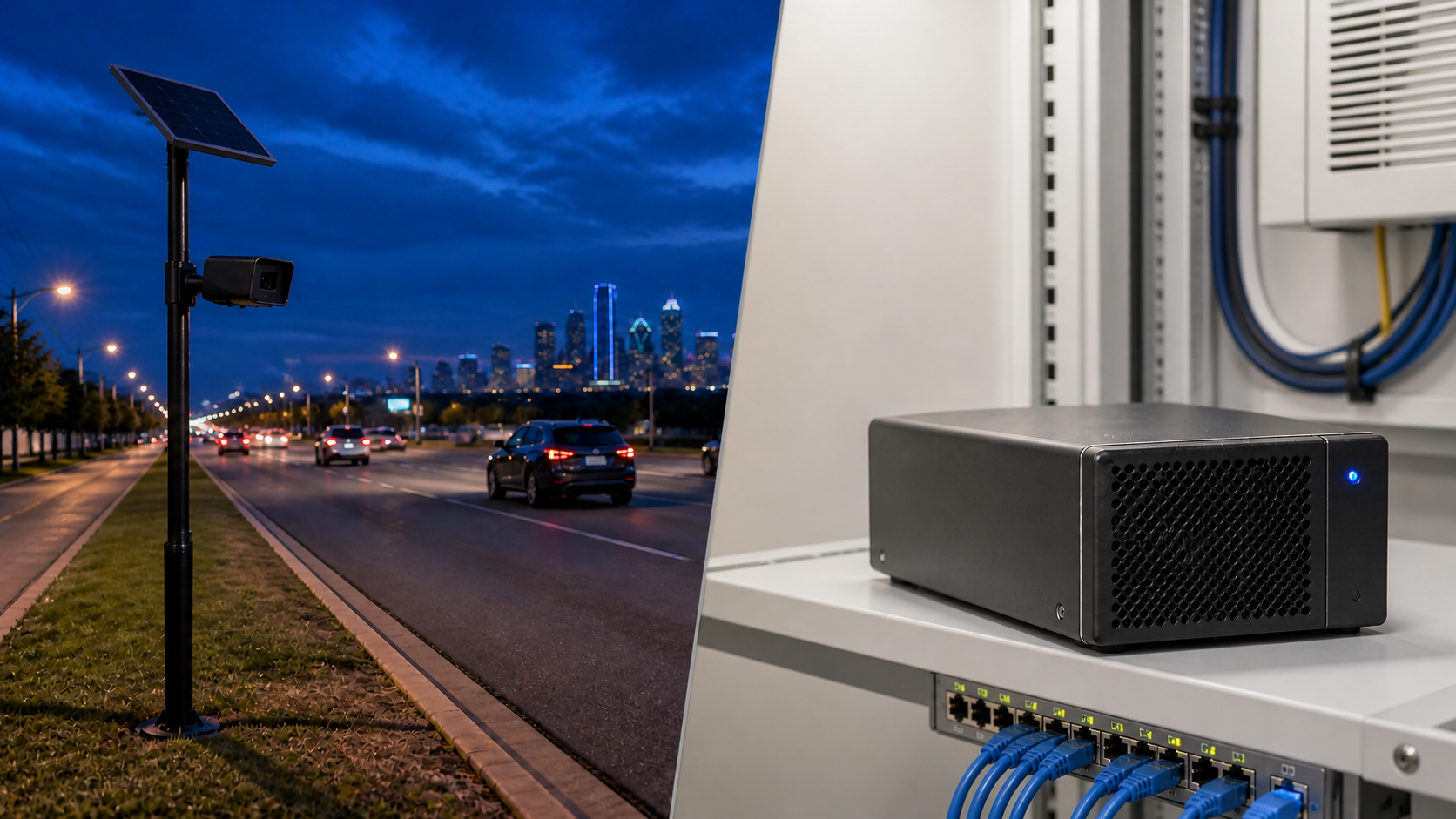
Kelltech offers Coram AI for organizations that want modern search and analytics while keeping the primary video workload at the property. Coram Point is an on-site AI video appliance that records video locally. Coram states that event detection, indexing, Discover search, and Journey processing run on the Coram Point rather than sending every video frame to an external AI service.
This local-first architecture can reduce continuous upstream bandwidth use and keep routine footage and AI processing within the customer’s environment. Authorized users can still use Coram’s encrypted web and mobile experience for remote access. Optional cloud archives, shared clips, alerts, and certain advanced workflows may use cloud services, so Kelltech documents the selected features and data flow during design. Privacy-first should mean understanding the architecture clearly—not pretending that every remote feature is completely disconnected from the cloud.
Capabilities available in a locally controlled design
- Local recording on Coram Point with retention sized for the property
- Natural-language video search for people, vehicles, clothing, and events
- Vehicle search and license plate recognition on compatible camera views
- Journey tracking across cameras for incident investigation
- Role-based access, secure sharing, and expiring links
- Remote viewing without uploading every continuous video stream for storage
- Support for many existing ONVIF and IP cameras, subject to compatibility review
- Optional cloud archive for selected evidence when the organization chooses it
Local AI is only one part of a privacy-first camera system
Hardware architecture helps, but policy and installation decisions matter just as much. A camera aimed too broadly, indefinite retention, shared administrator accounts, weak offboarding, or poorly governed exports can undermine an otherwise thoughtful platform.
Kelltech helps customers define camera placement, purpose, retention, user roles, alert rules, export procedures, signage, network segmentation, and service responsibilities. We can also evaluate existing cameras and cabling to determine what can remain, what should move, and what needs replacement. The result is a system designed around the property’s actual security needs rather than participation in a larger surveillance network.
A Dallas–Fort Worth Flock camera alternative with local support
Kelltech Systems has served North Texas since 1987. Our Dallas-based team designs, installs, and supports commercial video surveillance, AI analytics, access control, intrusion detection, monitoring, networks, and integrated security across Dallas, Fort Worth, Plano, Frisco, McKinney, Richardson, Irving, Arlington, and surrounding DFW communities.
That local presence matters during a replacement. Camera views need to be tested in real lighting. License plate capture depends on angle, speed, distance, shutter settings, and illumination. Storage must be calculated from camera count, resolution, frame rate, retention, and activity. Network and power conditions must be verified on-site. A useful alternative is not just a different subscription—it is a complete, supportable system.
Frequently asked questions about Flock camera alternatives
What is the best Flock camera alternative for a Dallas business?
The best choice depends on whether you need private-property surveillance, gate or parking-lot license plate recognition, a multi-site video platform, or access to a broader law-enforcement network. For organizations prioritizing private local storage and on-site AI, Coram AI is a strong option Kelltech can design and support. We compare requirements before recommending a platform.
Does Coram AI store video locally?
Yes. Coram states that video is stored locally on the Coram Point appliance at the customer site. Retention varies by appliance and configuration. Remote access is provided through Coram’s cloud-connected applications, and optional cloud archive is available for selected footage.
Is all Coram AI processing done on-site?
Coram states that core video indexing, event detection, Discover, and Journey AI processing run on Coram Point. Some optional features, alert verification, remote access, shared clips, metadata, or archived evidence can involve cloud services. Kelltech will map the proposed data flow so your team can approve the architecture and enabled features.
Can Kelltech reuse our existing security cameras?
Often, yes. Coram supports many standards-based IP cameras. Kelltech reviews camera compatibility, image quality, credentials, firmware, network health, and placement before determining which devices can be retained.
Can a private system still read license plates?
Yes. A properly designed private system can capture and search license plates at entrances, gates, drive lanes, and parking areas. Results depend heavily on camera selection and field conditions. The key difference is that your organization can choose a private architecture and governance model instead of automatically relying on a broadly shared network.
Plan a privacy-first video assessment
If you are replacing Flock cameras, comparing Flock Safety alternatives, or simply reconsidering how your organization handles video and vehicle data, Kelltech can evaluate the current system and present local, cloud, and hybrid options in plain language.
Explore Kelltech video surveillance and AI analytics, or contact our Dallas–Fort Worth team to schedule a site assessment.
Sources and further reading
- Associated Press: Flock announces changes amid privacy and misuse scrutiny
- Coram AI Trust Hub: storage, processing, access, transmission, and sharing
- Coram Point architecture and local video storage
- Coram AI: on-premises Discover and Journey processing
Product capabilities and policies change. Confirm current technical, contractual, legal, and retention requirements before deployment. This article is general information, not legal advice.